Credit: Archdiocese of Brisbane
by Barry de Silva
With the Catholic Church reflecting on the legacy of Pope Francis, few voices in the Australian Catholic Church offer the insight and perspective of Archbishop Emeritus Mark Coleridge, and former President of the Australian Catholic Bishops Conference. In this interview, Archbishop Mark shares his memories of Pope Francis, his first-hand experience of synodality in action, and his hopes for the Church under Pope Leo XIV.
What are your memories of the election of Pope Francis on 13 March 2013?
I had just become Archbishop of Brisbane, and I’d agreed to provide media commentary. I told the media they could call me when the election was complete. I went to bed, and around 3am my phone rang. Because the election had been quick, I assumed they’d elected Cardinal Scola from Milan, so I began preparing my comments on him.
Then the cardinal came out and said, “Georgium.” I thought, the only George I know is Pell – surely not. I had gone through the list of electors and crossed off the names I thought had no chance. One was the Archbishop of Buenos Aires – he was too old, and a judge. I was wrong.
When Pope Francis came out, he wore just the white soutane – no red cape or stole. Having worked in the papal court, that wasn’t appropriate for a new pope. He stood there silently. Then I thought, He has to say something. He’s the pope. Eventually, he said, “Good evening.” It was so ordinary. And when he died, his last words were “Good night.” Again, ordinary. That was Pope Francis. He was one of us.
You have said previously he was a Pope of surprises and creative disruption. What did that look like?
He was so unpredictable. I have friends who work in the Roman Curia, and a couple of times they said, with affection but also realism, that he was very difficult to work with because of how unpredictable and idiosyncratic he could be. I think there was something in his personality that enjoyed catching people off guard. He had a very lively sense of humour.
You were a strong supporter of Pope Francis’ vision for the Church as being synodal at every level, can you explain what this meant?
The first thing to say is that I don’t think it was just Pope Francis coming up with this strange idea of synodality. I think it was the word of the Holy Spirit. The word may seem new and strange, in fact, it’s profoundly traditional. And by tradition, I don’t just mean since Vatican II, but even into the first millennium of the Church’s history.
This moment was chosen by the Holy Spirit to work through Pope Francis and offer a gift, not only to the Church but to the world. It calls human beings to journey together, not as enemies, but as brothers and sisters.
I didn’t really understand what synodality was until I went to the second Synod of Bishops in 2015. During that Synod, I had a very powerful experience of synodality in action. Halfway through the three weeks, everything seemed disorganised, and many of us couldn’t see how we’d come up with anything worthwhile. But we did. It was astonishing. It showed me what discernment is, and what synodality really is. Working through the mess together until something surprising emerges, almost as a gift.
How did he shape the Church’s mission?
He said he’d rather a Church that’s bruised, battered, bloodied and broken out on the streets than a white church that has never left the protection of its fortress. He gave us a new sense of mission, looking out, engaging with the world – even though the world may seem hostile in many kinds of ways. If we can speak and act in the right way, find the right words and the right actions, the world can be strangely attentive.
One of the reasons the world was attentive to him, was, who else speaks of mercy in a merciless world? Who else speaks of justice in the midst of injustice? Who speaks of peace in the midst of violence? Who speaks of tenderness in the midst of brutality? No one else has the same platform to do it.
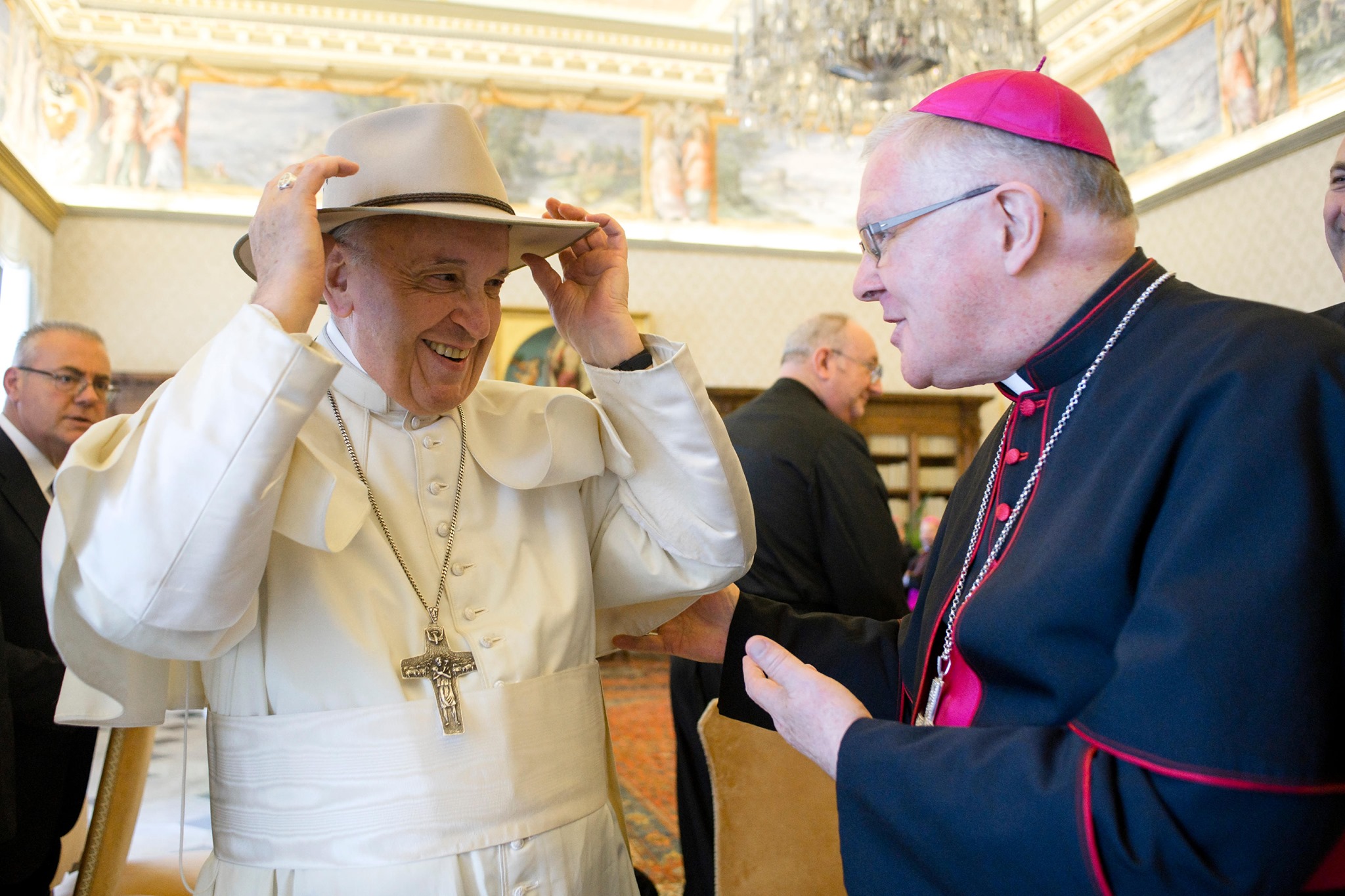
There’s a fantastic image of Pope Francis wearing an Akubra hat that you’d given him. Can you remember what you were discussing?
It was actually quite a brief exchange. That was during the ad limina visit, when all the bishops go to Rome every few years to pray at the tombs of the Apostles and meet with the pope and Vatican agencies. I was the president of the Australian Catholic Bishops Conference at the time.
We had brought the Akubra as a gift. He receives all kinds of gifts, but we thought this one was a bit special. I offered him the hat, and without any prompting, he put it on – it fitted him perfectly. I said, “That fits you perfectly and suits you extremely well. You should leave it on.” And he did.
He smiled very broadly. He had these lovely, bright eyes. When you met Pope Francis, you didn’t feel like you were talking to a very old man. There was a certain vivacity in his face, especially in his eyes, and he looked just like that in the photo. He was delighted.
I’m not sure what happened to the hat after that. They’ve got a big warehouse where they store a lot of items the pope is given – the most exotic array of items, so the Akubra is probably in there somewhere, gathering dust.
Did Pope Francis deepen your own faith?
Absolutely. Not only was my faith deepened and enriched by my contact with him, but also my sense of what it means to be a bishop. I learned certain things late in life that I wish I’d known earlier.
Credit: Archdiocese of Brisbane
What did you learn from him?
As a bishop you can’t be just an administrator or an academic, you’ve got to have mud on your boots. I learnt from Francis to open the ears, and to open the ears of the heart – that’s the heart of what it means to be a pastor, whether you’re a bishop or a parish priest.
What did he think of the Church in Australia?
He never visited Australia, although when it was said he might be travelling to Indonesia, Papua New Guinea, Singapore and Timor-Leste. I suggested to the Permanent Committee of Bishops that we invite him to stop into Darwin, particularly to visit Indigenous Australians.
He did know a fair bit about Australia. A couple of times when I mentioned I was from Australia; he recalled Jesuits here that he knew. I once gave him a book by one of them, and he spoke to me about that.
In this country, I’d say the clearest sign of his legacy is the Plenary Council and everything flowing from it. In Brisbane we had an important Synod, and other dioceses did too. It’s changed the way we think and act as a Church. I find it hard to believe there’s a country on earth where the Catholic Church hasn’t been seriously influenced by his ministry.
What parts of Pope Francis’ papacy do you hope to remain with Pope Leo XIV?
I think Pope Leo will certainly continue down the path of a synodal Church – one that listens with open ears and an open heart. He’ll listen to the cry of the earth and the cry of the poor.
I have no doubt he will also carry forward Pope Francis’ concern for climate change and care for our common home. That said, I think he’ll handle the papacy in a different way – probably more scripted and structured. Pope Francis could be very unpredictable at times.
Pope Leo previously worked in the Vatican Curia and served as Prefect of the Dicastery for Bishops. In some ways, that background may make him more attentive to the institutions of the Holy See.
He’s very much the heir of Pope Francis, but I believe he will be a more unifying presence as pope.
This article was originally published in the August 2025 edition of Catholic Life.